
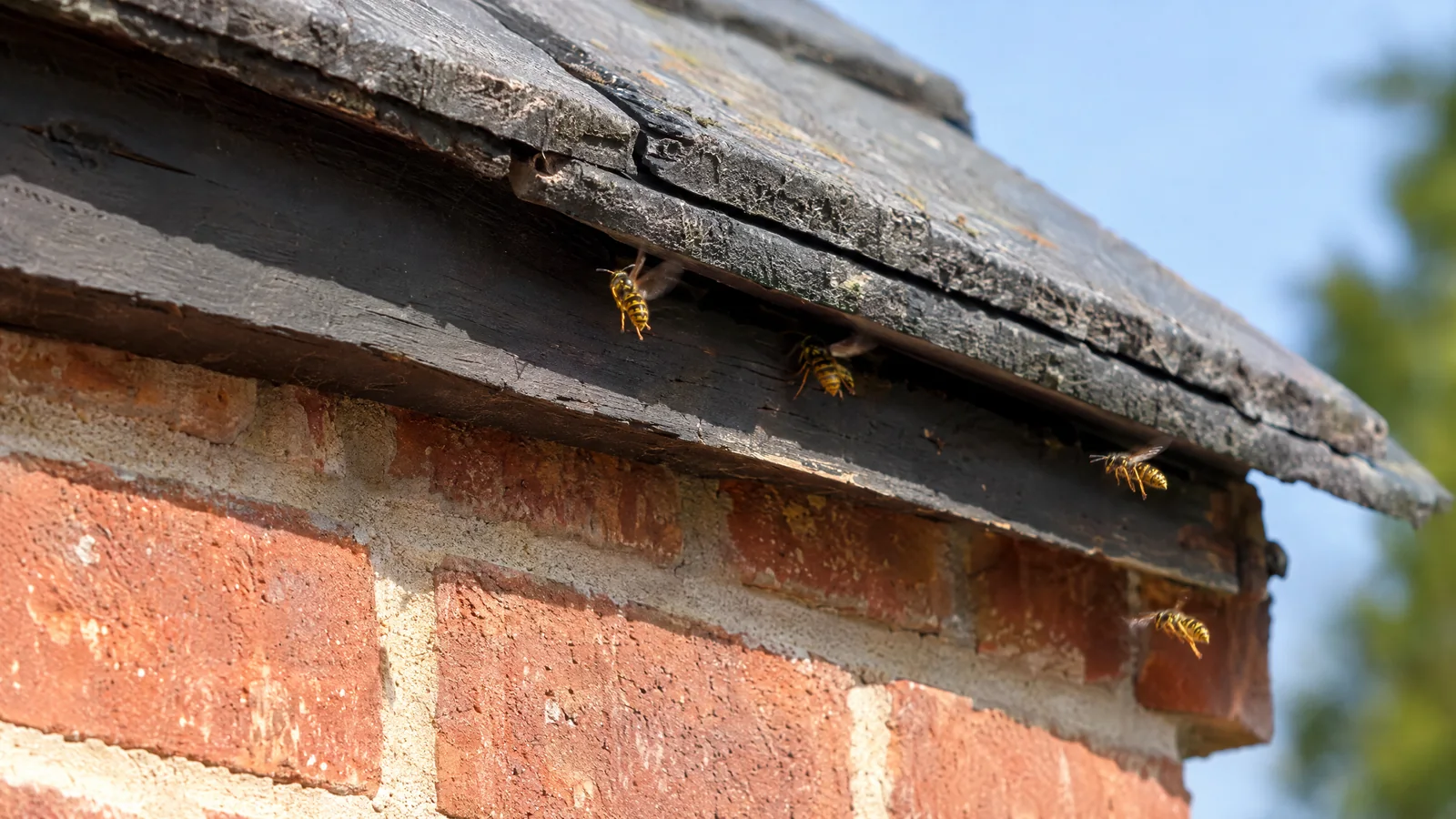
A steady stream of wasps at the eaves or shed? How to recognise a nest, why disturbing it is risky, and what professional wasp nest removal involves.
A few wasps around the bins in July is normal. A constant stream of them disappearing into the same gap under your roof is something else. That is almost always a nest, and if it is near a door, a window, a play area or a busy path, it is time to think about wasp nest removal.
Across Manchester, Stockport and Cheshire, wasp calls build through the summer and peak in late August and September, when colonies are at their biggest and wasps are at their most irritable. This guide explains how to recognise a nest, why it is not a job to take on yourself, and what happens when a Protec technician visits.
How a wasp nest grows over a season
Each nest begins in spring with a single queen who has spent the winter hidden in a shed, loft or pile of logs. She chews wood into a papery pulp, builds a small starter nest about the size of a golf ball and raises her first workers.
From there, the colony grows quickly. By midsummer a nest can be the size of a football or larger, with thousands of wasps. In late summer the colony produces new queens and males, the workers lose their usual food supply and start searching for sugar, which is when they become such a nuisance at picnics and pub gardens. With the first hard frosts the colony dies, the new queens leave to hibernate, and the old nest is not used again.
That timing matters. A nest spotted in June is smaller and less defensive than the same nest in September.
Where to look for a nest
You do not need to find the nest itself. Watching where the wasps go is usually enough, from a safe distance.
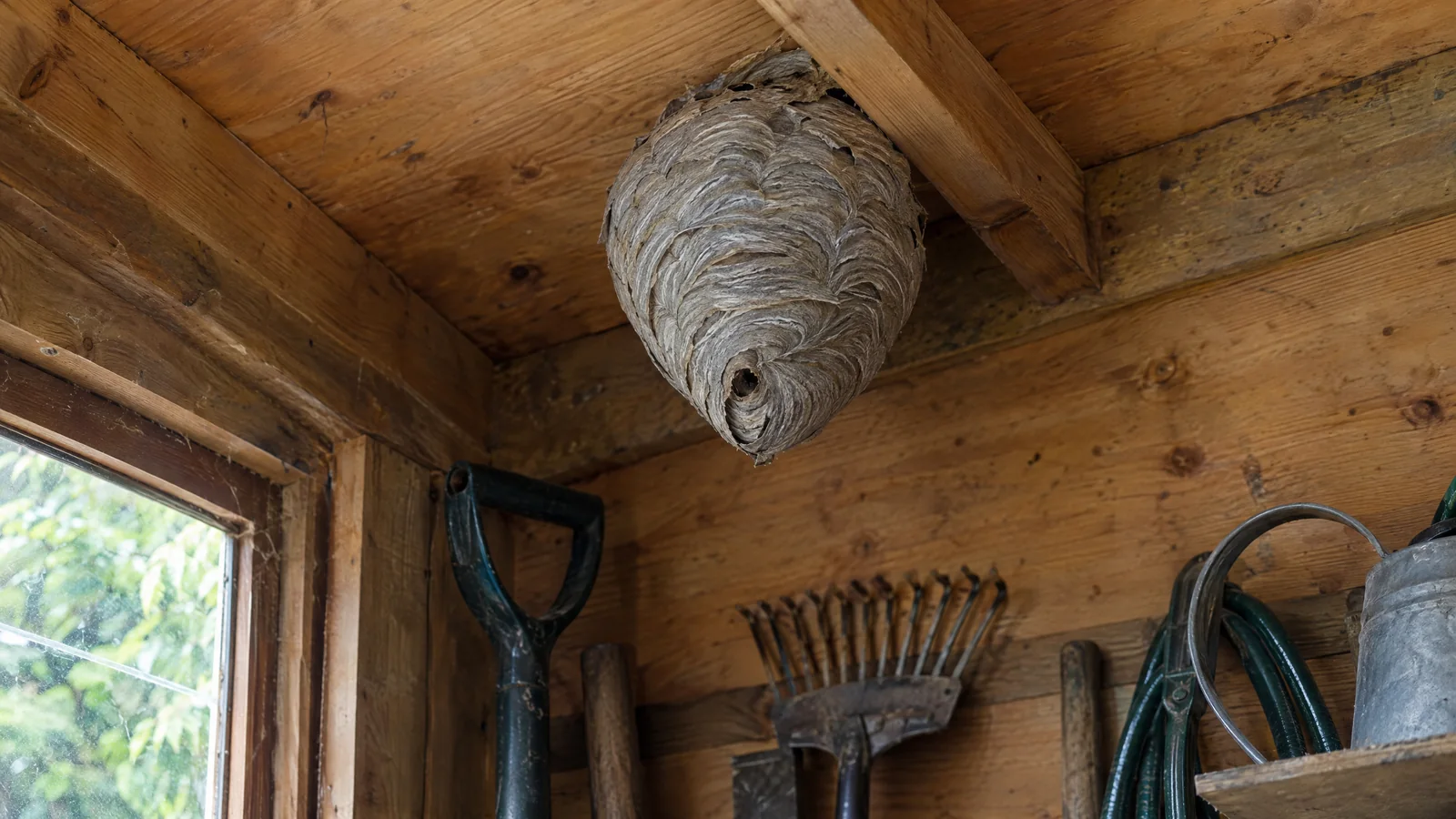
Common nest sites we see on local properties include:
- Roof spaces and eaves. Gaps under tiles, fascia boards and soffits are the most common entry points.
- Wall cavities and air bricks. Wasps flying in and out of the brickwork itself.
- Sheds, garages and outbuildings. Nests hang from roof timbers or sit in stored items.
- Underground. Old mouse holes and gaps under paving or decking.
- Hedges, bird boxes and compost bins. Particularly in larger Cheshire gardens.
If wasps are appearing inside, especially around a loft hatch or light fittings, the nest may be in the roof space or a wall. Close the door to that room and keep children and pets out.
Why wasp nests are worth taking seriously
Most wasps leave people alone, but a nest changes things. Wasps defend their nest, and when it is disturbed many can sting at once. For anyone with a known allergy, that can be serious. If you have any concern about a sting reaction, seek medical advice from NHS 111, or call 999 in an emergency.
There are practical issues too. A nest by a back door or a child's bedroom window makes part of the home unusable. In roof spaces, wasps can chew through soft materials and occasionally find their way indoors. For businesses, especially pubs, cafes and holiday lets, a busy nest near customers is a real problem.
If you have a nest close to where people live, work or play, call Protec on 0161 448 1782 and we can talk you through the options.
Why DIY wasp nest removal is a bad idea
Every summer we visit homes where someone has tried to deal with a nest themselves. The outcomes range from the nest being unaffected to the person being badly stung. Here is why we advise against it.
- Disturbance provokes the whole colony. Poking, spraying or knocking a nest triggers a defensive response that can involve hundreds of wasps.
- Nests are usually hard to reach. Working at height on ladders, or in a hot cramped loft, is dangerous enough without angry wasps.
- You may not reach the nest at all. The entrance you can see is often some distance from the nest inside a wall or roof.
- Shop-bought products are limited. They often only affect the wasps they touch, and the colony continues.
- Misidentification. Some insects that look like wasps are bees, which should not be treated in the same way.
A trained technician has full protective clothing, access equipment and the knowledge to deal with the nest safely, usually in a single visit.
What professional wasp nest removal involves
Our approach is straightforward. You call, describe where the wasps are and how high, and we arrange a visit.
The technician confirms that the insects are wasps, locates the nest entrance and checks for hazards such as height, nearby windows or people with allergies. They then treat the nest safely, explaining what they are doing and how long the wasps are likely to stay active afterwards. In most cases activity stops within a day or so.
You will be told whether the nest needs to be physically removed or can be left, as dead nests are not reused. Our page on getting rid of wasps nests explains more about our service.
Wasp nests across Manchester, Stockport and Cheshire
We deal with nests in every kind of property. Victorian terraces have gaps under slate roofs, interwar semis around Stockport have busy eaves, and Cheshire homes often have large gardens, outbuildings and hedges. Whether you need wasp control in Manchester, wasp control in Stockport or wasp nest treatment in Knutsford, our technicians know the local housing. You can find every area on our all wasp control areas page.
Not sure whether you are looking at wasps or bees? See our guide on how to tell a bee, wasp or hornet apart.
Frequently asked questions
How do I know if wasps have a nest nearby?
The clearest sign is a steady line of wasps flying in and out of one spot, such as a gap under the eaves, an air brick, a hole in the ground or a shed corner. Lots of wasps in one room or around the loft hatch can also point to a nest inside the roof space.
Is it safe to deal with a wasp nest myself?
We strongly advise against it. Disturbing a nest can provoke many wasps at once, and nests are often at height or in tight spaces such as lofts and wall cavities. Anyone with a known allergy to stings should keep well away. A trained technician has protective equipment and works safely.
Will the wasps go away on their own?
A nest is abandoned in late autumn as the colony dies off, and old nests are not reused. However, during the summer the colony keeps growing, and the risk of stings near doors, windows and play areas grows with it. If a nest is causing a problem, professional treatment is the sensible option.
Are those wasps or bees?
Wasps are smooth, shiny and bright yellow and black with a narrow waist. Bees are usually hairier and rounder. Bees are important pollinators and are treated differently, so it matters which you have. Our guide to telling bees, wasps and hornets apart explains the differences.
How do I book wasp nest removal with Protec?
Call 0161 448 1782 and tell us where the nest is, how high it is and how busy it looks. Protec covers Manchester, Stockport and Cheshire, including Knutsford, Wilmslow and Macclesfield. We will explain the visit and give you a clear quote before anything is booked.
Book wasp nest removal with Protec
If wasps are nesting near your home or business, do not risk tackling it yourself. Call Protec on 0161 448 1782, tell us where the nest is, and we will arrange a visit and a clear quote. You can also get in touch online, or read more on the Protec blog.
Questions answered
Frequently asked questions
How do I know if wasps have a nest nearby?
The clearest sign is a steady line of wasps flying in and out of one spot, such as a gap under the eaves, an air brick, a hole in the ground or a shed corner. Lots of wasps in one room or around the loft hatch can also point to a nest inside the roof space.
Is it safe to deal with a wasp nest myself?
We strongly advise against it. Disturbing a nest can provoke many wasps at once, and nests are often at height or in tight spaces such as lofts and wall cavities. Anyone with a known allergy to stings should keep well away. A trained technician has protective equipment and works safely.
Will the wasps go away on their own?
A nest is abandoned in late autumn as the colony dies off, and old nests are not reused. However, during the summer the colony keeps growing, and the risk of stings near doors, windows and play areas grows with it. If a nest is causing a problem, professional treatment is the sensible option.
Are those wasps or bees?
Wasps are smooth, shiny and bright yellow and black with a narrow waist. Bees are usually hairier and rounder. Bees are important pollinators and are treated differently, so it matters which you have. Our guide to telling bees, wasps and hornets apart explains the differences.
How do I book wasp nest removal with Protec?
Call 0161 448 1782 and tell us where the nest is, how high it is and how busy it looks. Protec covers Manchester, Stockport and Cheshire, including Knutsford, Wilmslow and Macclesfield. We will explain the visit and give you a clear quote before anything is booked.
Need pest control advice?
Talk to Protec about your pest problem.
Call for clear advice and the right next step for your property.